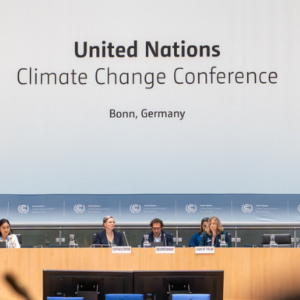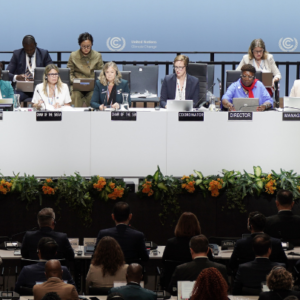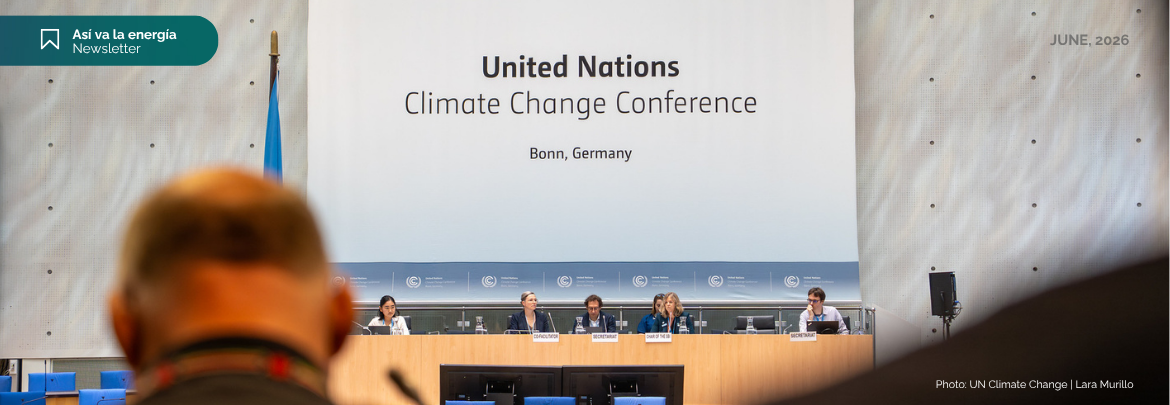
June is one of the most important moments globally for climate advocacy. Two events are drawing the international community’s attention around just energy transition (JET): the 64th Session of the Subsidiary Bodies of the United Nations Framework Convention on Climate Change (SB64, Bonn, June 8–18) and the London Climate Action Week (LCAW 2026, June 20–28).
From Así va la Energía, we break down what is being negotiated, what is at stake, and what Latin America needs to avoid being left behind.
SB64 in Bonn: Where political agreements take technical shape
SB64 is the intersessional meeting of the two technical bodies of the UNFCCC: the Subsidiary Body for Scientific and Technological Advice (SBSTA) and the Subsidiary Body for Implementation (SBI). Their role is to prepare draft decisions that governments will adopt at the 31st Conference of the Parties (COP31), to be held in Antalya, Turkey, in November 2026.
Although it tends to go unnoticed by the general public, SB64 is one of the most influential spaces in the climate process: this is where the agreements that governments later adopt at COP are built.
This meeting also includes the UAE Dialogue and sessions on the UAE Just Transition Work Programme and the Mitigation Work Programme. Here is what each one involves and what is at stake:
The UAE Dialogue on the Global Stocktake
Adopted at COP28 in Dubai to follow up on the Global Stocktake (GST), this event aims to facilitate an exchange of experiences on the challenges and opportunities countries have identified when implementing the signals sent by the first GST. The dialogue places particular emphasis on strengthening international cooperation and means of implementation, including financing, capacity building, and technology transfer. During SB64 in Bonn, countries will seek to move this exchange from theory to practice and will define its connection to the second global stocktake.
If these conversations do not translate into concrete signals about the structural barriers to overcome and the support required for a just energy transition, there will be no adequate diagnosis to understand the level of progress in implementing the targets of the first GST, nor the key input expected for the next one.
The UAE Just Transition Work Programme (UAE JTWP)
One of the most notable outcomes of COP30 in Belém was the decision mandating the development of a Just Transition Mechanism under the work programme of the same name (JTWP). Its primary objective will be to strengthen international cooperation, technical assistance, capacity building, and knowledge exchange to enable just and inclusive transitions.
SB64 will be decisive because countries must agree on both the governance and the operating modalities of this mechanism, in a way that also allows it to become operational as soon as possible.
For it to have real impact, this mechanism must support countries in achieving a just transition away from fossil fuels, advancing toward a renewable energy-based economy aligned with energy efficiency and avoiding replicating the harmful practices of fossil extractivism.
This transition must place communities and workers at the center — those who need to diversify not only their economic activity, but also their capabilities to move away from dependence on a fossil-fuel economy.
The Mitigation Work Programme (MWP)
Discussions on the Mitigation Work Programme continue to face disagreements among countries over the programme’s continuation. While it has enabled an exchange of experiences on how countries are advancing their mitigation targets, it has so far produced few concrete results in terms of signals to increase ambition in the collective effort to reduce emissions.
At COP31, it will be evaluated whether the work programme should continue. While the only existing space for discussing mitigation under the Convention must be preserved, it must change the way it operates so that it genuinely fulfills the purpose for which it was created: safeguarding ambition and the implementation of mitigation targets under the Paris Agreement.
London Climate Action Week (LCAW): Where civil society takes the floor
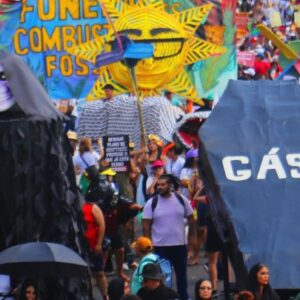
The other crucial stage at this point in the year is the eighth edition of LCAW 2026 — the largest independent climate gathering in Europe — positioning itself as one of the main multi-stakeholder spaces where governments, civil society, multilateral entities, the private sector, and climate finance funds converge. With more than 750 events spread across the city, the week functions as an alliance-building platform between COPs, and carries special weight in 2026, as the second GST takes its first steps.
LCAW is a strategic window to position the Latin American perspective on JET before actors with real influence over climate finance and global energy policy.
And where is Latin America’s voice?
As negotiations advance in the corridors of Bonn and multi-stakeholder exchanges in London draw near, a network of civil society organizations from Latin America and the Caribbean is building its own collective response: a regional just energy transition roadmap. Its goal is to guide the region’s governments toward an orderly and just phase-out of fossil fuel production and use, on a timeline that does not extend beyond 2050 and that is consistent with the 1.5°C scenario established in the Paris Agreement.
The roadmap proposes concrete actions for the coming years, recognizing that transforming energy systems requires simultaneous changes across multiple sectors and structural transformations in our countries’ economies.
Comprehensive solutions combining the accelerated deployment of renewable energy, electrification, and energy efficiency — alongside improved development and land-use planning that keeps the most vulnerable communities, people, and ecosystems at the center.
Bonn and London will be the first spaces in 2026 where this proposal can be presented, build alliances, and gather international support. The roadmap will be delivered to the COP30 Presidency as a regional civil society contribution, to inform the global process led by Brazil and announced in Belém.
To learn more about this roadmap — developed by more than 40 Latin American civil society organizations and encompassing 12 principles, 14 targets, around 30 sub-targets, and more than 70 actionable solutions — you can access it here.
The Role of Así va la Energía in these processes
Así va la Energía en América Latina is a platform that evaluates the progress of countries in the region across six essential dimensions of JET: renewable energy expansion, energy efficiency, elimination of fossil fuel subsidies, fossil fuel phase-out, clean energy investment, and justice in the transition.
For Bonn and LCAW, the platform focuses on four core areas:
| Evaluate | Compliance with paragraph 28 of the GST in 6 Latin American countries, using verifiable and comparable indicators. |
| Contrast | The pace of change among Latin American countries: who is advancing, who is falling behind, and where the bottlenecks lie. |
| Inform | Research, technical documents, and advocacy actions around JET with solid evidence that can feed into deliberations among countries. |
| Connect | Multilateral commitments with national and regional realities, putting data at the service of communities, researchers, and decision-makers. |
Because a just transition does not negotiate itself: it is built with information, with alliances, and with voices that do not go silent.